For six hundred years, Indian artists have returned to the same two figures. Radha and Krishna, standing together in the half-light of Vrindavan the god with his flute, the golden consort with her veil have inspired more original canvas paintings than any other subject in the subcontinent’s artistic history.
This guide is written by the artists of Artace Studio, a Pune-based studio with over a decade of experience creating Radha Krishna painting drawing on canvases on original commission. Whether you are here to understand the drawing process, choose the right style for your home, follow Vastu guidance, or find the right original artwork as a gift you will find the answer here, directly from the studio.
The Eternal Story That Inspired Indian Painters for Centuries
The Radha Krishna painting tradition does not begin with a brush. It begins with the Gita Govinda, the 12th-century Sanskrit poem by Jayadeva widely considered the most influential text in Indian devotional art. Jayadeva’s descriptions of Radha’s longing, Krishna’s divine play, and the lush poetry of their reunion gave Indian artists a vocabulary they have never stopped drawing from.
What makes this subject so durable in Indian homes is not purely religious. It is emotional. A Radha Krishna painting in the living room of a Mumbai apartment or a Delhi NCR villa communicates something beyond piety it signals depth, cultural literacy, and an appreciation for beauty that is distinctly Indian. It is, in the language of interior design, a statement piece that carries its own meaning.
According to Google Trends data analysed across 2020–2026, searches for Radha Krishna paintings in India peak by approximately 340% in the four weeks surrounding Janmashtami, with the highest concentration of demand from Maharashtra, Uttar Pradesh, and Rajasthan. But the subject is not seasonal it commands 40,000–55,000 monthly searches year-round, making it the single highest-traffic devotional art category in the country.
How to Draw Radha Krishna: Proportions, Symbols & Sketch Basics
Before a single brushstroke touches canvas at Artace Studio, there is a pencil. The drawing phase is where the painting’s soul is decided the tilt of Krishna’s hip, the angle of Radha’s gaze, the precise arc of his peacock-feathered crown. For anyone learning to draw Radha Krishna, understanding these fundamentals will immediately improve the quality of the sketch.
Essential Symbols Every Radha Krishna Drawing Must Include
A Radha Krishna drawing that omits its symbolic elements is technically competent but artistically incomplete. These are the elements our artists consider non-negotiable:
Krishna’s elements:
- The Murli (flute): Held horizontally at the lips or resting in both hands the instrument that called all of Vrindavan to listen. Draw it as a slender cylinder, slightly tapered, never too thick.
- The Peacock Feather: Placed in the crown, single feather, the eye of the feather facing forward. This is Krishna’s most recognised visual marker.
- The Pitambara (yellow dhoti): The deep mustard or golden-yellow garment draped from the waist. In pencil sketch form, this is conveyed through the fabric’s movement and folds.
- The Vanmala (forest garland): A long garland of wildflowers reaching the knees. In sketch form, show it as a series of soft curved forms, not a rigid chain.
Radha’s elements:
- The Ghunghat (veil): Draped loosely over the head, one corner held this single gesture communicates both modesty and longing in Indian visual culture.
- The Lotus: Often held in one hand, or positioned near her feet. Draw it as a fully open bloom, never a bud.
- The Chunri (dupatta): Often rendered in red or saffron in final paintings. In pencil, focus on the flowing movement of the fabric.
Pencil Sketch Technique: From Outline to Expressive Line Work
The proportions that define a classical Radha Krishna pencil drawing begin with the vertical axis. Krishna is typically taller, his weight shifted onto one leg in the tribhanga (triple-bend) posture hips, shoulders, and neck each at a slight angle. This creates the graceful S-curve that is the visual signature of Krishna in all Indian classical styles.
Step-by-step proportion guide for beginners:
- Establish the height axis first. Draw a light central vertical line. Krishna occupies approximately 8 head-heights. Radha, positioned slightly lower or at the same level, is 7 to 7.5 head-heights.
- Sketch the tribhanga first. Mark three points of bend knee, hip, and opposite shoulder before drawing any facial detail. The posture defines the entire composition.
- Heads last, not first. Beginners draw the face first and then struggle to fit the body. Sketch the full body framework, then position the heads.
- Hands carry expression. In Indian art, the hands (mudras) communicate as much as the face. Spend proportionally more time on hand posture than on clothing detail.
- Use hatching, not shading, for volume. Classical Radha Krishna pencil drawings use fine parallel lines to indicate form. Heavy graphite shading changes the visual character entirely.

The 5 Radha Krishna Painting Styles: A Visual Comparison Guide
India has not one Radha Krishna painting tradition. It has five distinct visual languages, each rooted in a specific geography, material tradition, and devotional context. Understanding these differences is not academic it is the practical foundation for choosing the right painting for a specific room, a specific wall, and a specific intention.
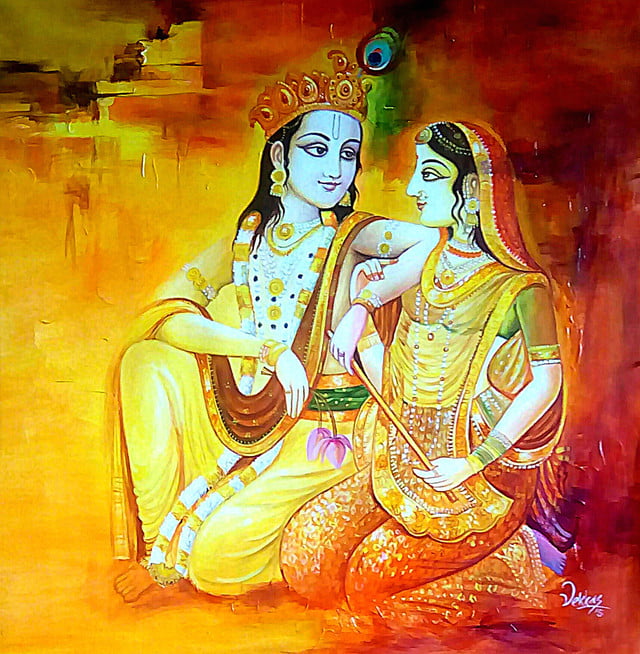
Pichwai Temple-Born, Gold-Leafed Devotion
Pichwai paintings originate from Nathdwara, Rajasthan the temple town of Shrinathji, a form of Krishna. The word pichwai means “that which hangs behind” these large cloth paintings were originally created as temple backdrops, hung behind the deity’s idol during specific devotional festivals.
Visual character: Flattened, non-perspective compositions. Rich, jewel-tone backgrounds deep indigo, forest green, saffron orange. Extensive gold leaf detailing on jewellery, ornaments, and lotus fields. Krishna is always the central focal point; Radha and the gopis arrange themselves in patterns around him.
Material signature: The original Pichwai tradition uses natural mineral pigments on cloth. At Artace Studio, we recreate Pichwai-inspired canvases using archival-quality acrylics and genuine gold leaf foil to achieve the warm luminosity of the original without compromising durability.
Best for: Pooja rooms, prayer alcoves, formal living rooms where a deep spiritual atmosphere is desired. Also works exceptionally well in high-ceilinged spaces the large-format, symmetrical composition holds the scale.
What to avoid: Do not place a Pichwai in a bedroom where the gold-on-dark palette can feel visually heavy in a space meant for rest.
Madhubani Folk Art of Bihar’s Sacred Forests
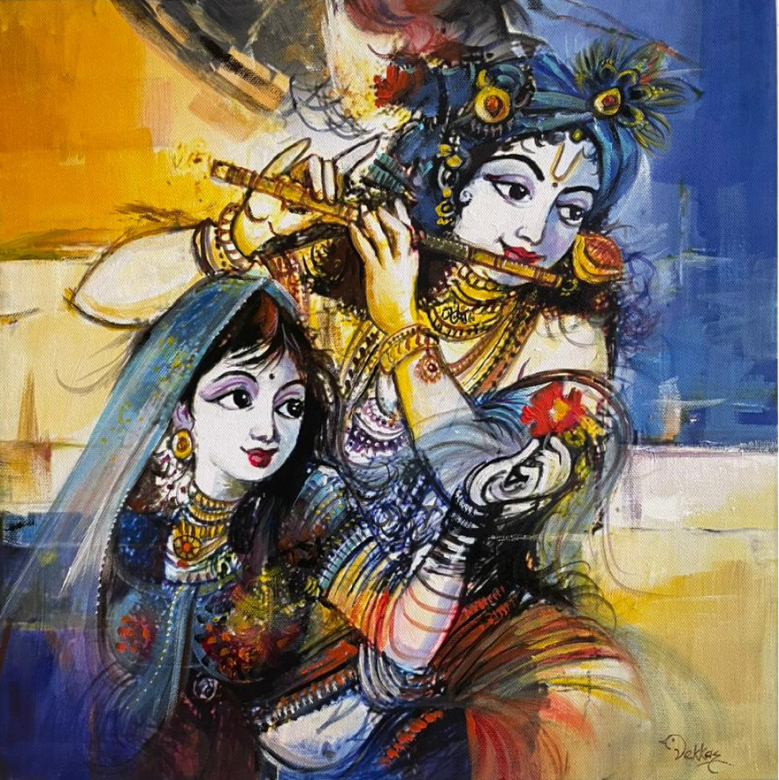
Madhubani (also called Mithila) painting comes from the Mithila region of Bihar and Nepal, where women painted the walls of their homes to mark celebrations births, marriages, harvests. The tradition is at least 2,500 years old; references appear in the Ramayana, when King Janak commissioned Mithila artists for Sita’s wedding.
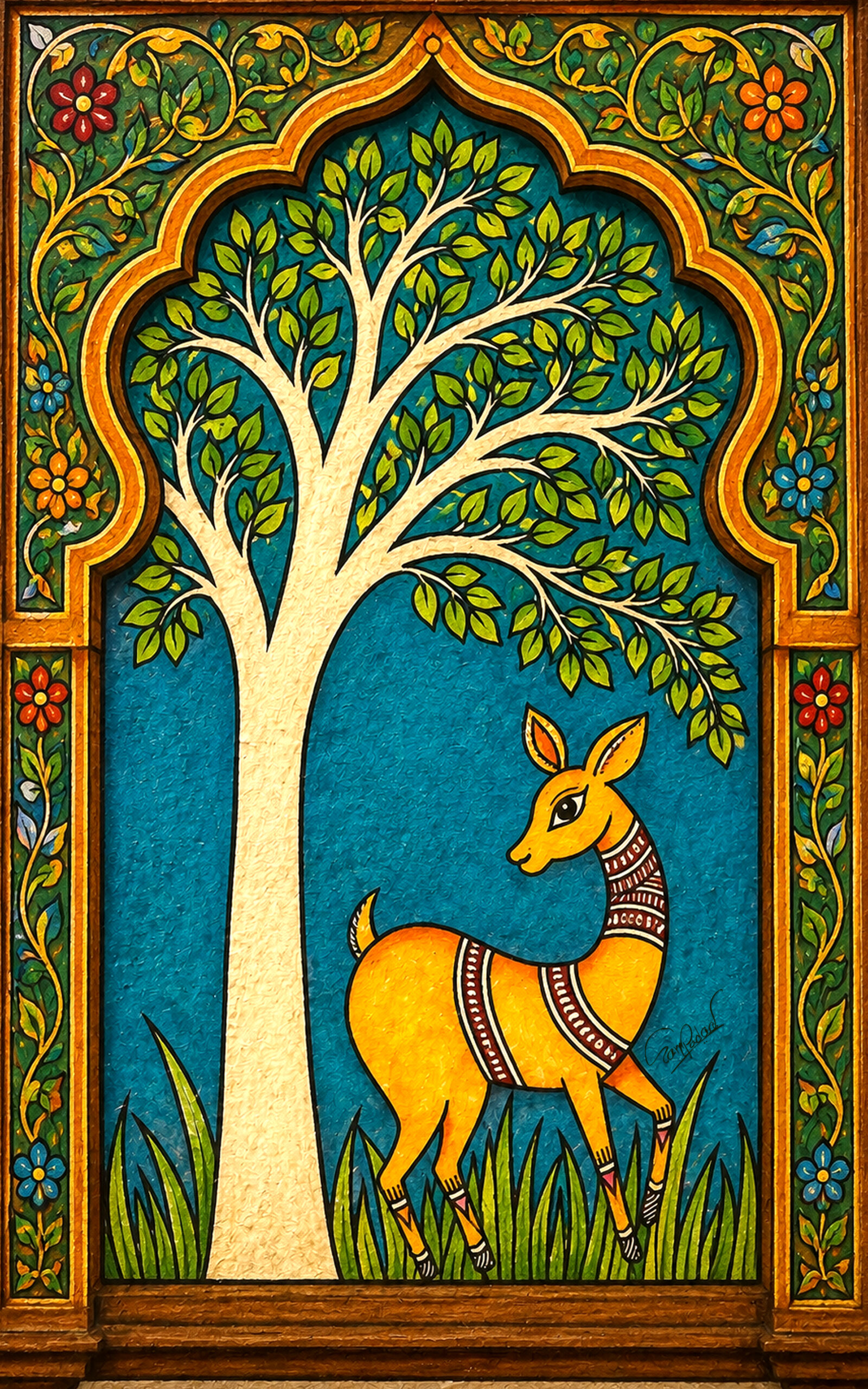
Visual character: Bold, flat black outlines. Intricate geometric fills concentric circles, fish-scale patterns, floral motifs. Every inch of negative space is filled. The effect is simultaneously complex and joyful. Radha and Krishna are drawn with wide, elongated eyes, and surrounded by natural imagery fish, parrots, lotus ponds.
Material signature: Traditional Madhubani uses natural pigments made from turmeric, indigo, and cow dung paste on handmade paper or cloth. Our Madhubani-influenced canvases use archival-quality acrylics that replicate the earthy colour palette while ensuring the work lasts decades.
Best for: Study rooms, creative offices, hallways, children’s bedrooms. The folk vibrancy and intricate patterning make it a natural conversation starter in informal, intellectual spaces.
Tanjore South India’s Jewelled Canvas Tradition
Tanjore (Thanjavur) painting is arguably India’s most technically demanding classical tradition. Originating from the Maratha court of Thanjavur in Tamil Nadu, it reached its peak in the 16th–18th centuries and is distinguished by its three-dimensional relief work, embedded semi-precious stones, and real gold foil that catches light from across a room.
Visual character: Rich, warm backgrounds in deep red and green. Figures rendered in a highly stylised form with large, expressive eyes and elaborate jewellery. The defining feature is the raised gesso work figures literally stand in slight three-dimensional relief from the canvas surface, covered in gold foil and embedded with coloured glass or genuine stones.
Material signature: At Artace Studio, our Tanjore-style Radha Krishna canvases use the traditional chalk-and-adhesive relief technique for the gesso work, genuine 22-karat gold foil, and Swarovski-quality glass stones for embellishment. These are among the most labour-intensive pieces we produce a single 24″×36″ canvas takes 12–18 days.
Best for: Formal dining rooms, reception areas, executive offices. The gold and relief work create a presence that commands attention without noise. In Vastu terms, Tanjore works particularly well on north-facing walls, where the gold catches incoming natural light.
Mughal Miniature Persian Refinement Meets Bhakti Devotion
The Mughal miniature tradition arrived in India with Humayun, who brought Persian court painters to the Mughal court in the 16th century. As the tradition evolved under Akbar and Jahangir, it absorbed Hindu devotional themes including Radha Krishna creating a visual vocabulary that fuses Persian refinement with the warmth of Bhakti spirituality.
Visual character: Small, extraordinarily detailed compositions. Figures are set within landscapes of lush, stylised foliage. The colour palette is cooler and more muted than Pichwai or Tanjore soft pinks, muted golds, dusky greens. The most notable technical signature is the ultra-fine brushwork: true Mughal miniatures use brushes made from three to five squirrel hairs.
Material signature: Traditional Mughal miniatures are on wasli (layered handmade paper). Our Mughal-inspired Radha Krishna paintings recreate this refined quality on premium cotton canvas, retaining the cool palette and intricate detailing at a scale suited to contemporary walls.Best for: Private libraries, executive home offices, collector’s display walls. The scale and detail reward close examination these are not paintings to hang at the end of a long corridor. Place them at eye level in intimate spaces where they can be properly seen.
Modern Acrylic Contemporary Interiors, Timeless Theme
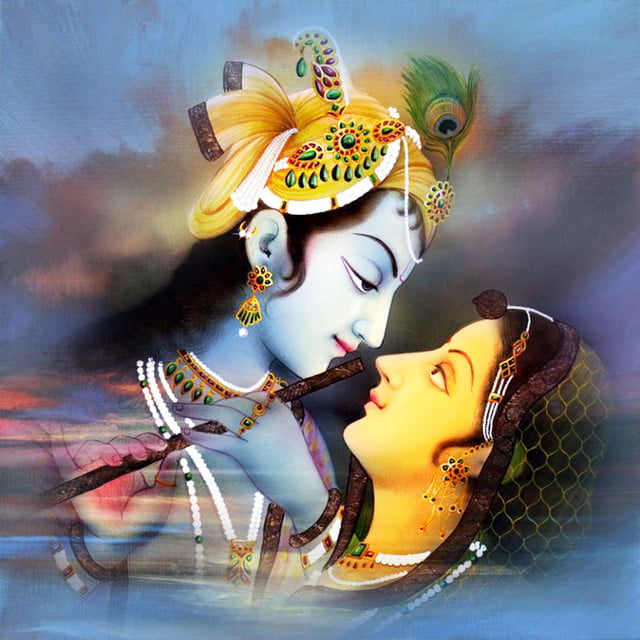
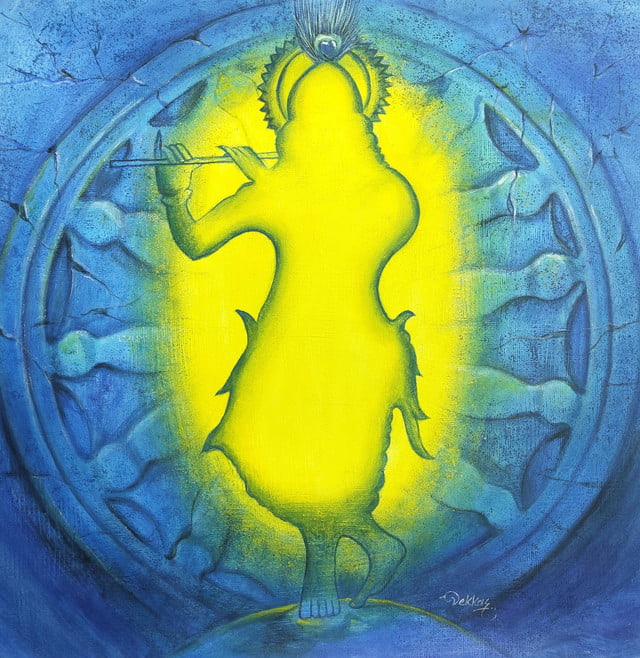
The most collected style at Artace Studio is also the most misunderstood. “Modern Radha Krishna” is not a compromise or a westernised dilution of the tradition. It is a legitimate contemporary art form one in which trained Indian artists use the full visual language of modern acrylic painting to explore the same emotional themes that Pichwai and Madhubani artists have explored for centuries.
Visual character: Ranges from semi-abstract to highly realistic. Common approaches include: a soft-focus impressionist treatment where Radha and Krishna merge with a wash of blue and gold; a bold, graphic style with strong outline and contemporary flat-colour fills; or a richly textured, palette-knife-heavy acrylic treatment where the physicality of the paint surface is itself part of the artwork.
Material signature: Artace Studio’s modern Radha Krishna canvases use professional-grade artist acrylics on premium 400-gram cotton canvas, stretched on seasoned kiln-dried wooden frames. Unlike digital prints or decorative posters, every piece carries the tactile signature of the artist’s hand visible brushstrokes, impasto texture, and a surface that changes character with the light throughout the day.
Best for: Contemporary apartments, open-plan living spaces, minimalist interiors where a classic devotional theme is desired without heavy traditional ornamentation. The versatility of the modern acrylic style means we can customise the palette to complement any interior.
Radha Krishna Painting Direction as per Vastu Shastra
Vastu Shastra governs the energetic placement of objects in a space, and among devotional paintings, Radha Krishna carries specific Vastu significance. The combination of divine love, spiritual harmony, and Krishna’s association with prosperity and positivity makes this subject one of the most auspicious artworks you can place in a home or office.
The primary rule: A Radha Krishna painting should ideally face east or north in any room. The painting should be on the north-east wall (so it faces south-west), as the north-east is the Ishanya corner the zone of divine energy, spiritual growth, and clarity of mind.

Room-by-Room Placement Guide
Living Room: The north-east wall is the first choice. If the layout doesn’t allow for it, the east-facing wall is the acceptable alternative. Do not place a Radha Krishna painting on the south wall, which is associated with Yama (the deity of death) in Vastu, nor on the west wall, which faces the setting sun symbolically inauspicious for a deity of love and life.
Size guidance: For a standard 10×12 living room, a 24″×36″ canvas is the minimum presence. A 30″×48″ canvas creates the statement a devotional painting deserves.
Bedroom: This is one of the most frequently asked Vastu questions regarding Radha Krishna paintings. Vastu Shastra permits a Radha Krishna painting in the bedroom specifically because the image represents divine, pure love, which is considered auspicious for marital harmony. Place it on the east-facing wall, ideally at or slightly above eye level when standing.
Avoid placing any religious painting above the bed’s headboard or directly opposite the bedroom door.
Pooja Room: The pooja room is the natural home for a Pichwai or Tanjore Radha Krishna painting. Here, the north or east wall is correct. The painting should be at the same level as or slightly above the main deity idol, never below. Size should be proportional to the space a 16″×24″ or 18″×24″ canvas is appropriate for most residential pooja rooms.
Office / Study: The north-east corner of a workspace is associated with mental clarity, good decision-making, and spiritual support for one’s endeavours. A Madhubani or modern acrylic Radha Krishna in this position is considered Vastu-supportive for professional activity.

Gifting a Radha Krishna Painting: Occasions & What to Choose
A hand-painted Radha Krishna canvas from an original studio is one of the few gifts in the Indian market that carries both aesthetic and spiritual weight. It is the kind of acquisition that occupies a wall for thirty years, that guests ask about, and that eventually becomes part of a family’s material history.
Janmashtami: The most significant occasion for a Radha Krishna-specific gift. Searches for Radha Krishna paintings and drawings in India spike 340% in the weeks surrounding Janmashtami (typically August). Our recommendation: for gifting to a family home, a Pichwai-style or modern acrylic canvas in blue-gold tonality. Allow 15–18 days lead time if ordering a custom-sized piece before the festival.
Wedding & Anniversary: The symbolism of Radha and Krishna as the archetype of divine love makes this subject the single most appropriate wedding gift from India’s classical visual tradition. For a newly married couple, our artists recommend the modern acrylic style the palette can be customised to complement the couple’s interior aesthetic, and the subject communicates a blessing that no generic artwork can offer.
A framed, conservation-glass-mounted canvas in 24″×36″ or 30″×48″ is the appropriate scale for a wedding gift.
Housewarming: A Radha Krishna painting at a griha pravesh carries auspiciousness by design. For a housewarming, we recommend either a Tanjore-style piece (the gold catches the puja room’s lamp light beautifully) or a medium-format modern acrylic that can anchor the living room while the new homeowners are still deciding on their full interior direction.
Corporate Gifting: At Artace Studio, we have fulfilled corporate gifting commissions for companies recognising senior retirements, long-service milestones, and festive season giving at the board level. A hand-painted original canvas, delivered with a Certificate of Authenticity and conservation packaging, communicates a quality of consideration that no marketplace print can approach.
Minimum order for corporate gifting: 5 pieces. Custom branding and dedication inscription available.
Shop Artace Studio’s Hand-Painted Radha Krishna Collection
Artace Studio has been painting original Radha Krishna canvases from our studio in Pune since 2010. Every painting leaves our studio with a signed Certificate of Authenticity, professional conservation packaging, and the option for framing in our in-house workshop.
We do not sell prints. We do not sell pre-made inventory. Every canvas you see in our collection is either made-to-order or available as a one-of-a-kind original.
Our Radha Krishna Collection includes:
- Pichwai-style Radha Krishna Deep-tone backgrounds, genuine gold foil accents, temple-art aesthetic. Available from 18″×24″ to 48″×60″.
- Madhubani Radha Krishna Folk-art patterning in earthy pigment palette, archival quality. Available from 12″×18″ to 36″×48″.
- Tanjore-style Radha Krishna Three-dimensional gesso relief, 22-karat gold foil, stone embellishment. Available from 18″×24″ to 36″×48″. Lead time: 18–22 days.
- Modern Acrylic Radha Krishna Fully customisable palette and style direction. Available from 12″×12″ to 60″×48″ and custom sizes.
About our artists: The Artace Studio Radha Krishna collection is the work of artists who have spent over 15 years exclusively focused on Indian devotional art. Our lead artists trained in classical Indian techniques before developing the studio’s contemporary practice which means our modern Radha Krishna paintings carry the proportions, symbolism, and compositional principles of the classical tradition, even when expressed in a contemporary visual language.
In Closing
Six hundred years after the Gita Govinda first gave Indian artists a language for divine love, Radha Krishna paintings remain the most emotionally resonant subject in the Indian home. The tradition has not survived by accident. It has survived because every generation of artists has found something new to say through these two figures and every home that chooses an original, hand-painted canvas chooses to be part of that conversation.
A Radha Krishna painting drawing is, ultimately, an act of attention. When our artists pick up the pencil and begin the first sketch, they are making the same decision that Pichwai painters made in Nathdwara, that Madhubani women made on their wedding walls to give this subject the time and care it deserves.
If you are ready to acquire an original hand-painted Radha Krishna canvas for your home, office, or as a gift, we invite you to begin with a conversation.