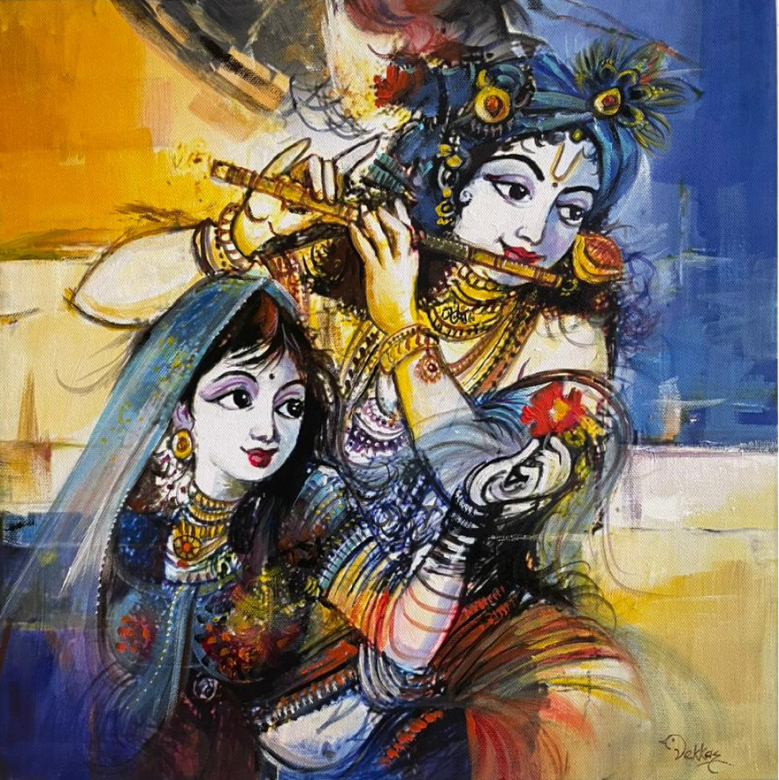
Radha Krishna is the most commissioned subject in Tanjore art for a reason, the gold-embossed relief work seems to hold light the way devotion holds a home. But the moment you start searching, you’ll find the market crowded with paintings that call themselves “Tanjore” while using nothing more than gold-toned acrylic paint.
This guide will help you tell the difference, choose the right size and placement, and understand what you’re actually paying for.
What Makes a Painting a Tanjore Painting
Tanjore Paintings Radha Krishna is a classical South Indian art form that originated in the town of Thanjavur in the 16th century, under the patronage of the Maratha court. It’s built in layers: a wooden base, a cloth ground, a gesso paste worked into raised relief for jewellery and architectural details, and finally, genuine gold foil pressed over the relief by hand.
This is what separates a real Tanjore piece from a print or a gold-paint imitation. The relief work stands physically off the canvas, you can run a finger over Krishna’s crown and feel the ridge where an artisan built it up, layer by layer, over several days.

Tanjore vs. Mysore vs. Madhubani vs. Pichwai: How Radha Krishna Is Painted Across India
Radha Krishna appears in almost every classical Indian art tradition, and each region interprets the pair differently. If you’re comparing styles before you buy, here’s how to tell them apart at a glance.
Tanjore
Bold, gold-heavy, and dimensional. Deep jewel tones, ruby red, emerald green, royal blue, sit against gold relief and semi-precious stone inlay. The figures are stylised and formal, built for devotional focus rather than realism.
Mysore
Softer and more delicate than Tanjore. Mysore work uses thinner, flatter gold leaf rather than raised relief, and the colour palette leans toward pastel washes with fine, intricate linework in the faces and drapery.
Madhubani
Entirely different in temperament, flat, folk-art compositions from Bihar built from dense line patterns, natural pigments, and no gold at all. Radha Krishna here feels earthy and narrative rather than ornamental.
Pichwai
Traditionally painted behind the deity Shrinathji in Rajasthani temples, Pichwai work is rich in narrative detail — cows, lotus ponds, monsoon skies — with Krishna often shown as a child or cowherd rather than in the formal Radha Krishna pairing.

If it’s the raised gold relief and jewel-toned formality you’re drawn to, Tanjore is your style. If you want something flatter and more pastel, ask specifically for Mysore, the two are frequently mislabelled in online listings.
How to Verify an Authentic Tanjore Radha Krishna Painting
Because “Tanjore-style” prints and gold-paint reproductions are common, it helps to know what to check before you commit. A genuine piece will hold up to all four of these.
1. Ask what’s under the gold
Real Tanjore work uses 22k or 24k gold foil laid over a hand-built gesso relief. Ask the seller directly, a studio that made the piece will answer this without hesitation. A reseller usually cannot.
2. Feel the relief
Gold foil pressed over genuine gesso has depth,Krishna’s crown, Radha’s jewellery, and the architectural borders should stand visibly off the canvas. Flat, printed gold has no texture at all.
3. Check the stone-setting
Traditional Tanjore work often sets small glass or semi-precious stones into the jewellery and crown areas. These should be individually embedded, not printed as a pattern.
4. Ask for the studio’s process, not just the certificate
A certificate of authenticity is useful, but a studio that can describe its own process, how the base is prepared, how many days the gesso work takes, where the gold is sourced from, is telling you something a marketplace listing can’t.

Where to Place a Tanjore Paintings Radha Krishna at Home
Vastu placement is one of the most common questions we’re asked about Radha Krishna paintings, and it’s worth approaching thoughtfully rather than as fixed law.
According to commonly cited Vastu Shastra principles, the east or north wall of the home is considered favourable for devotional art, particularly in the pooja room or living area facing the entrance. Radha Krishna is generally placed at eye level or slightly above, rather than too close to the floor, and many households avoid the bedroom for large devotional pieces, reserving those for shared spaces instead.
A note on this: Vastu guidance varies by practitioner and by household tradition. If placement is important to you, we’d always recommend a conversation with a Vastu consultant alongside these general principles, think of this as a starting point, not a rulebook.

Size and Price Guide for Tanjore Paintings Radha Krishna
Pricing for a genuine Tanjore piece depends on three things: the size of the canvas, the density of the gold relief work, and whether stone-setting is included. Here’s a general guide.
| Size | Typical Use | Approx. Price Range (₹) |
|---|---|---|
| Small (10″ x 12″) | Pooja room shelf, study nook | ₹5,000 – ₹8,500 |
| Medium (14″ x 18″) | Living room feature wall, gifting | ₹8,500 – ₹14,000 |
| Large (18″ x 24″ and above) | Entryway, formal living space, statement wall | ₹14,000 – ₹20,000+ |
Prices vary with gold density, stone-setting detail, and framing choice.

The Right Occasions to Gift or Display a Tanjore Paintings Radha Krishna
Radha Krishna’s pairing represents devotion and union, which is part of why it’s one of the most requested gifting subjects we work with.
- Housewarmings – a piece for the new home’s pooja space or entryway
- Weddings and anniversaries – the Radha Krishna theme carries obvious symbolic weight for a couple
- Janmashtami – the single busiest season for Krishna commissions, worth planning ahead for
- Naming ceremonies and milestone gifts – a lasting piece rather than a consumable gift
- Corporate and festive gifting – for clients or teams where a devotional, handcrafted gift reads as more considered than a standard hamper
Caring for Your Tanjore Painting
Gold foil and gesso relief are durable, but a little care keeps them looking their best for decades.
- Keep the piece out of direct, prolonged sunlight, which can dull the gold over many years
- Dust gently with a dry, soft cloth, avoid liquid cleaners near the relief work
- Hang away from high-humidity spaces like bathrooms or unventilated kitchens
- Have the frame checked periodically if the piece travels or is reframed
Why We Make These the Way We Do
We’re not a marketplace reselling other people’s work, every Radha Krishna Tanjore piece that leaves our studio was built here, by hand, from a raw canvas.
In our studio, the gesso base is built up over several sessions, left to set between layers, before a single sheet of gold foil is pressed on. It’s slow work by design, the relief needs time to hold its shape, and rushing it is the first thing that separates a lasting piece from one that flattens within a year.
We’ve made this painting for pooja rooms, for wedding gifts, and, more than once, for a client who simply wanted to see Radha and Krishna on their living room wall every morning. If you’re commissioning one, we’ll talk you through gold density, size, and framing before anything is started, so there are no surprises when the piece arrives.
Conclusion
A Tanjore paintings Radha Krishna is a considered piece, one where the gold relief, the size, and the placement all matter to how it lives in your home. Take the time to verify the craftsmanship, and the piece will hold both its beauty and its value for years.
If you’re ready to bring one into your space, explore our Tanjore paintings Radha Krishna or reach out for a short consultation, we’re happy to walk you through gold density, sizing, and framing before you decide.