The price on the listing is rarely the price that reaches your door. Freight, import tax and a customs form can change the figure, and a printed reproduction passed off as handwork can change the meaning of the purchase entirely.
If you plan to buy Madhubani painting online from India, three questions matter more than the colour palette. Is the work what the seller says it is? Will it survive the journey? And what will it cost once it clears customs in your country?
This guide answers all three, with sources and dates. We’re a working art studio, so we have opinions. We state them plainly.
The short version
- Authenticity: check the line, the surface and the artist’s name. The GI tag alone proves little.
- Shipping: choose a rolled, unframed painting for overseas delivery.
- Cost: add freight and import tax for your country before you compare prices.
What You’re Buying: Madhubani, Mithila and the GI Tag
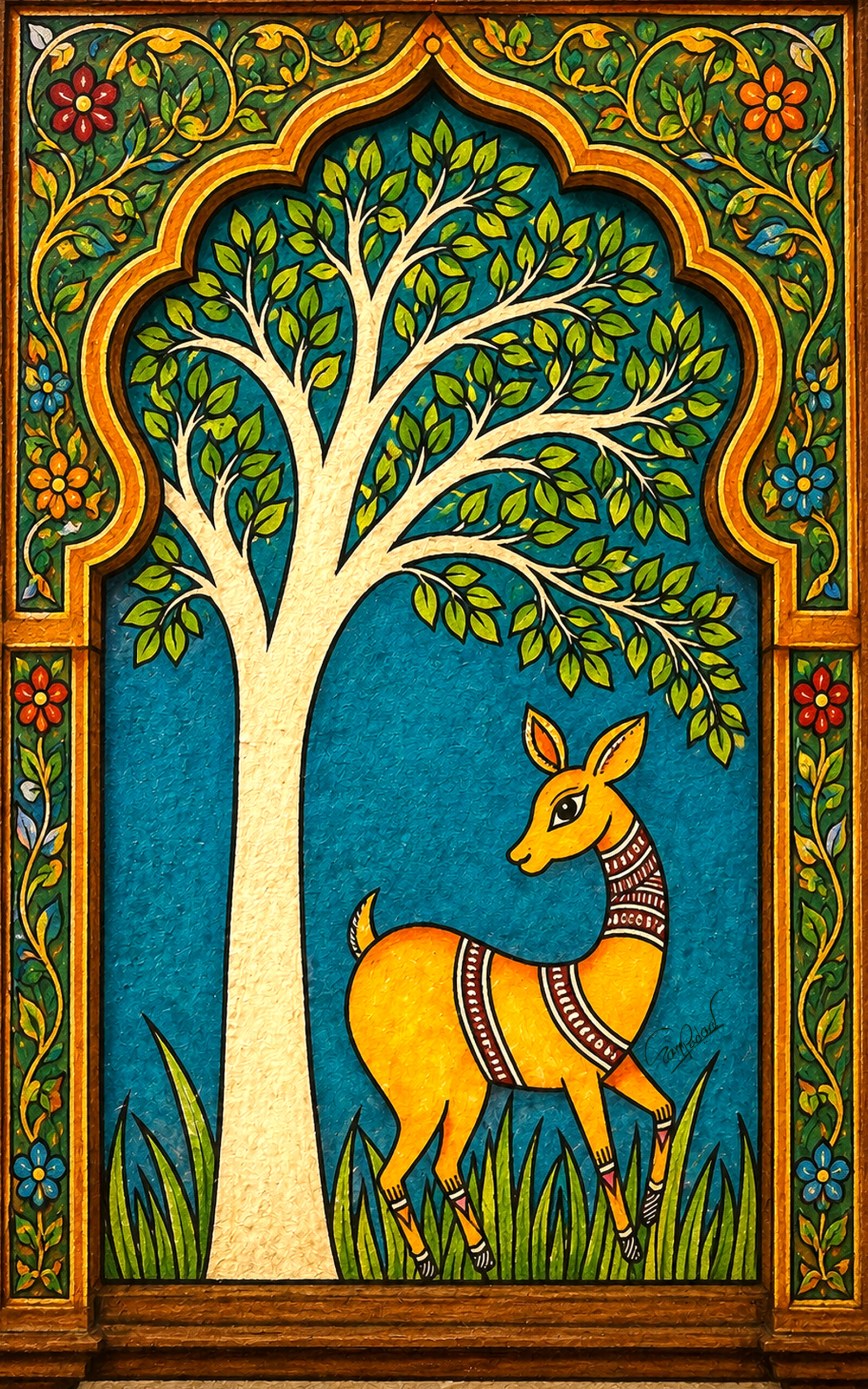
Madhubani painting, also called Mithila art, comes from the Mithila region of Bihar. Women painted it on freshly plastered mud walls and courtyard floors, using rice paste, plant dyes and brushes made from bamboo and cotton.
In the 1960s the tradition moved onto handmade paper, and later onto cloth and canvas, so that it could travel and earn a living for its painters.
Five styles shape what you’ll see in a listing:
- Bharni: bold colour filled inside double-lined figures, often deities.
- Kachni: fine line and hatching with restrained colour.
- Tantrik: goddess imagery and symbolic geometry.
- Godna: tattoo-inspired repeating patterns, usually black and earth tones.
- Kohbar: lotus, bamboo, fish and bird motifs tied to marriage and prosperity.
Knowing the style helps you question a seller. A listing that calls a colour-filled deity scene “Kachni” has told you something about its research.

What the GI tag actually means
In 2007, Madhubani painting received a Geographical Indication (GI) tag. The application, made by Bihar’s Directorate of Industries, covers three formats: wall paintings, line paintings and Godna paintings.
A GI protects the name “Madhubani” for work made in the Mithila region. It doesn’t certify quality, and it doesn’t tell you whether the painter received a fair share of what you paid. Down To Earth reports that the registry lists only 51 authorised users, while hundreds of households in the single village of Jitwarpur include a practising painter.
Weighing Madhubani against other traditions? Our Tanjore buyer’s guide compares four of them side by side.
So a missing GI number doesn’t prove a work is false. A GI mention in a listing doesn’t prove it’s genuine. Ask for the artist’s name and village instead.
Reading the label on a listing
Words on a product page carry different weight. Here is how we read them.
| Label on the listing | What it usually means | What to ask |
|---|---|---|
| “Madhubani painting” | The tradition’s name, often used loosely | Where was it painted, and by whom? |
| “Madhubani-style” or “inspired by” | Painted outside the tradition’s home region, or a contemporary take | Is the seller upfront about this? |
| “Mithila art” | Another name for the same tradition | The same two questions |
| “Hand-painted” | Painted by a person, not printed | Can you see process photographs? |
| “Original” | One-off, not a reproduction | Is there a certificate with a reference number? |
None of these labels is wrong on its own. The trouble starts when a listing uses all of them at once and answers none of the questions.
Where Artace Studio stands
We’re a studio in Pune, not in Mithila. Our Madhubani paintings are original works by our own artists, inspired by the tradition and painted by hand on canvas. We call them Madhubani-style. We don’t claim a GI.
If you want work from the Mithila region by a named local painter, say so to any seller you contact, us included. An honest label is worth more than a borrowed one.
The 7-Point Test Before You Buy Madhubani Painting Online
Wondering how to identify an original Madhubani painting? No single test settles it, so run all seven. An authentic Madhubani painting passes most of them. A printed reproduction usually fails the first two.
1. Look at the line
Madhubani outlines are drawn twice, a double line, with the space between filled by hatching or dots. A brush or a nib wobbles. Slight changes in pressure, tiny overlaps and restarts are the signature of a hand.
Perfect, mechanical uniformity at full enlargement is the warning sign.

2. Look at the surface
Ask for a macro photograph. Handmade paper shows visible fibres and a soft, irregular edge. Canvas shows its weave beneath the paint, and acrylic brushstrokes catch the light as tiny ridges.
A printed reproduction looks flat under magnification, often with a regular dot pattern. Ask for a short video, tilted slowly under a window. Paint has depth. Ink on a coated sheet reflects evenly.

3. Check that no space is left empty
The tradition dislikes a blank. Gaps are filled with flowers, birds, fish and geometric patterns. A composition with generous empty background can still be lovely, but it’s contemporary rather than traditional, and the seller should say so.
4. Ask where the colour comes from
Traditional pigments came from turmeric, indigo, flower juice, leaves and soot, bound with natural gum. Many working artists now use acrylics, which is a legitimate choice and travels better.
The test isn’t which one a seller uses. It’s whether they tell you. You can’t judge pigment by eye, so ask. A seller who answers with specifics about colours, binder and surface has handled the work.
5. Find the artist
A named artist, a signature and a short biography let you verify the work. A generic maker name such as “emporium” or “collective” tells you very little.
6. Read the certificate
A useful certificate carries the artist’s name, the title, the date, the size, the medium and surface, a unique reference number and the seller’s signature, ideally with a photograph of the work. One line saying “authenticity certificate provided” is a claim, not a document.
Ask to see a sample before you pay.
7. Question the price, then ask for process photographs
A struck-through price under a permanent half-price banner is a pricing tactic, not an appraisal. Handwork has a floor. A large, finely detailed painting priced like a greeting card deserves a question.
Then ask for work-in-progress photographs. A painter can send a sketch, a half-filled border and the finished piece. A reseller usually can’t.
Paper, Canvas, Framed or Rolled: What Survives the Journey
Paper is the traditional surface, and it looks wonderful. It’s also the more delicate to ship. It creases, absorbs moisture and tears at the corners, so it often travels flat in a rigid board package, which adds to freight.
Canvas is more forgiving. Acrylic on canvas rolls well when the paint is fully dry and the roll is wide. Ask the seller how long the painting has dried before it was packed.
A sound rolled shipment has interleaving paper over the painted surface, a wide rigid tube, firm end caps and an outer carton. Ask for a photograph of the packing before it leaves.
Framed work is a different matter. Glass can break in transit, frames add weight, and freight rises with volume. Some marketplaces won’t ship framed paintings outside India at all, so check the terms for Madhubani painting international shipping before you pay.
Our advice to overseas buyers is to take the painting unframed and rolled, then commission bespoke framing near you, with archival quality acid-free mounts and UV-filtering glass chosen for your wall.

Customs and Import Tax by Country
Last verified: 13 November 2026. Rules change, and the links below go to official or primary pages. A licensed broker or your courier will confirm the final figure.
If you buy Madhubani art from India, landed cost is simple arithmetic: painting price, plus shipping and insurance, plus import duty, plus import tax (VAT or GST), plus any courier clearance fee. Work it out for your country before you pay.
Two habits help everywhere. Make sure the invoice describes an original hand-painted painting, with the artist, title and value. And ask for the commodity code. Original hand-painted works sit under tariff heading 9701, and the right code is what triggers reduced or zero rates.
United States
The USD 800 duty-free threshold is gone. Duty-free de minimis treatment has been suspended for all countries since 29 August 2025, and CBP’s rules of 24 June 2026 made the suspension indefinite. In practice, every shipment needs a customs entry, and postal parcels now use a postal informal entry process.
Paintings made entirely by hand are classified under HTS 9701.10, and CBP rulings on such paintings state a general duty rate of Free, with an invoice naming the painting, the artist and the value.
US tariff policy shifted repeatedly through 2025 and 2026, so other measures tied to the country of origin may apply. Ask your courier or a licensed customs broker to confirm the current total, and be wary of any listing that promises “no customs duty” without a date.
United Kingdom
The UK treats original hand-painted work kindly. HMRC values it at 25% of its value plus costs, then applies 20% VAT, an effective rate of 5%. Take a painting at £1,000 with £100 of freight: 5% of £1,100 is £55.
HMRC has confirmed that the reduced rate is open to individuals as well as businesses. The catch is paperwork. If the commodity code is missing, a courier may charge the standard 20%, and you’d have to reclaim the difference.
Australia
Australia draws the line at A$1,000. Below that customs value, no GST or duty is collected at the border, though a GST-registered overseas seller may add GST at checkout. Above it, a formal import declaration is lodged, and GST is payable at the border. The 10% rate applies to the customs value plus any duty plus international freight and insurance.
Example: a A$1,500 painting with A$150 of freight and insurance, and no duty, carries GST of 10% of A$1,650, which is A$165. Ask your broker whether duty applies to original paintings under their tariff heading.
Canada
The Canada Border Services Agency lists original paintings as duty-free in its 2026 tariff. GST of 5% still applies, according to a customs-broker guide, and some provinces add or substitute HST. Expect a formal assessment from the courier even when no duty is owed.
Singapore
Singapore charges 9% GST on imports, worked out on the CIF value plus any duty. Goods arriving by air or post with a CIF value of S$400 or less get relief. Above S$400, GST applies to the full value, and sea or land consignments get no relief.
Example: a S$800 painting with S$100 of freight and insurance, and no duty, carries GST of 9% of S$900, which is S$81.
The five countries at a glance
| Country | Duty on hand-painted originals | Import tax |
|---|---|---|
| United States | Generally Free (HTS 9701.10); other measures may apply | None federally; entry now required on every shipment |
| United Kingdom | Generally nil with the correct code | Effective 5% VAT |
| Australia | Free | 10% GST above A$1,000 customs value |
| Canada | Free | 5% GST, plus HST in some provinces |
| Singapore | Free | 9% GST; relief only up to S$400 by air or post |
What a Madhubani Painting Costs, and What Each Price Tier Buys
Madhubani painting price depends on size, detail, the artist’s standing and the surface. The same four factors apply to original Madhubani paintings for sale and to a commission.
In listings we reviewed in November 2026, named artists on handmade paper ranged from roughly ₹4,700 to ₹18,500. One 22 by 30 inch painting was listed at ₹12,000. Work by senior painters is priced well above that.
Treat these as rough bands, not rules:
- Entry, under about ₹5,000: small paper works, often unattributed. Lovely as a gift. Ask who painted it.
- Mid-range, about ₹5,000 to ₹20,000: named artist, handmade paper or canvas, medium sizes. Most collectors begin here.
- Upper tier, above that: large, intricate or senior-artist works, and bespoke commissions made to your wall.
Add freight and tax from the section above before you compare offers. A low sticker price with heavy freight can end up costing more than a fairer-priced work.
Where to Buy: Artists, Marketplaces or a Studio
When you buy a Madhubani painting online, there are three broad routes, and each trades something for something else.
Large online catalogues give you choice and familiar checkout. The trade-off is thin attribution. Listings are often templated, the maker is sometimes a generic name, and the return terms for overseas orders can be strict. Read them before you fall for a painting.
Buying from Mithila painters or cooperatives puts you closest to the tradition, and it’s the route to take if a GI-region work by a named painter matters to you. Expect slower replies and more effort on packing and paperwork. Ask how payment reaches the artist.
A studio like ours adds guidance and a made-to-order process, and an honest Madhubani-style label in place of a GI claim. We’re not the right choice if you specifically want a Mithila-made piece.
With only 51 authorised users on the GI registry, many working painters sit outside it. So “who is paid?” is a fair question to put to any seller of a handmade Madhubani painting. A good one answers it without hesitation.
The Seller Checklist: Returns, Damage and Paperwork
Before you pay, ask these eight questions:
- Who painted it, and will that name appear on the certificate?
- Can you see work-in-progress photographs?
- Is the painting made to order or from stock, and what is the lead time?
- How is it packed, and is it insured door to door?
- What is the damage-claim window, and what evidence is needed? An unboxing video is common.
- Are international orders returnable? Some sellers treat them as final.
- Who pays duty and tax, you or the seller?
- Will the invoice carry the artist, title, medium and value for customs?
Get the answers in writing. A seller who is slow to answer eight plain questions will be slower after payment.
When the Painting Arrives: Unboxing, Inspection and Hanging
Film the unboxing from the first cut of the tape. Some sellers set a short damage-claim window, such as 48 hours, and ask for video evidence. Keep the tube, the end caps and the packing, and photograph any damage before you touch the painting.
Unroll it slowly. Lay a canvas face up on a clean, flat surface and give it a day to relax before it goes near a frame. Never iron or press a painted surface. Paper works should rest under clean board, not weights placed straight on the pigment.
Take it to a framer who works with archival materials. Acid-free mounts and UV-filtering glass protect colour for years. Hang it away from direct sun and damp, which is standard advice for any painting. Our art care guide covers the basics.
How Artace Studio Handles an Overseas Commission
Every Artace painting is made to order. That helps an overseas buyer more than it might seem, because most of the risks above are risks of surprise.
You approve a concept sketch before any paint touches the canvas. You confirm the palette against your own walls. You receive progress photographs as the work develops, and you give final approval before it is packed. Nothing arrives that you haven’t already seen.
Our Deer Madhubani painting is a good piece to hold the seven tests against, because it’s a studio work you can study in detail photographs. If another folk idiom speaks to you, we also paint Warli. Buyers in Britain can begin with our UK page.

Placement questions come up often. Fish and lotus motifs are traditionally tied to fertility and prosperity in Kohbar painting, and some buyers also consult a Vastu practitioner about direction. Beliefs vary, so treat that as a personal choice. We’re happy to talk through your wall, whether it’s a Singapore apartment, a London hallway or a boardroom in Gurugram.
Your Next Step
To buy a Madhubani painting online from India well, check the hand, the journey and the arithmetic. Run the seven tests. Choose a rolled, unframed format. Work out your landed cost before you pay. That protects most of what matters.
What remains is the pleasure of the work itself: the double line drawn by a steady hand, the colour settling into canvas, a wall that finally has something to say. That is an investment in your space, and worth doing slowly.
If you’d like to make an acquisition, browse the studio or write to us and we’ll arrange a consultation. We’ll talk you through the sketch, the palette and the route to your door.