You found a Madhubani painting online. The colours glow and the lines look crisp. Even the price feels fair. Then the doubt arrives: is this an original Madhubani painting, or a very good print?
It is a fair worry. A screen flatters everything, and a printed copy photographs beautifully. Your hands and a small torch will tell you the truth in about five minutes.
Original Madhubani Painting: A 7-Step Checklist
Run as many of these as you can. One clue proves little. Several together are hard to fake.
- Find the double line. Outlines and borders should be drawn as two parallel strokes, never a single line.
- Look for empty space. A genuine piece fills almost the whole surface with pattern, flora, fish or figures.
- Tilt it under a torch. Light skimmed across the surface shows tiny ridges where paint was laid down. Ink from a printer lies flat.
- Use a 10x loupe. Paint looks continuous with soft brush edges. A print breaks into dots.
- Watch the line. A hand-drawn line swells and thins. Repeated motifs should resemble each other, never match.
- Turn it over. Check the back, the edges and the paper or canvas for signs of a mass-produced copy.
- Ask for proof. A real artist has a name, a village or cooperative, and process photos.

What Makes a Madhubani Painting Madhubani?
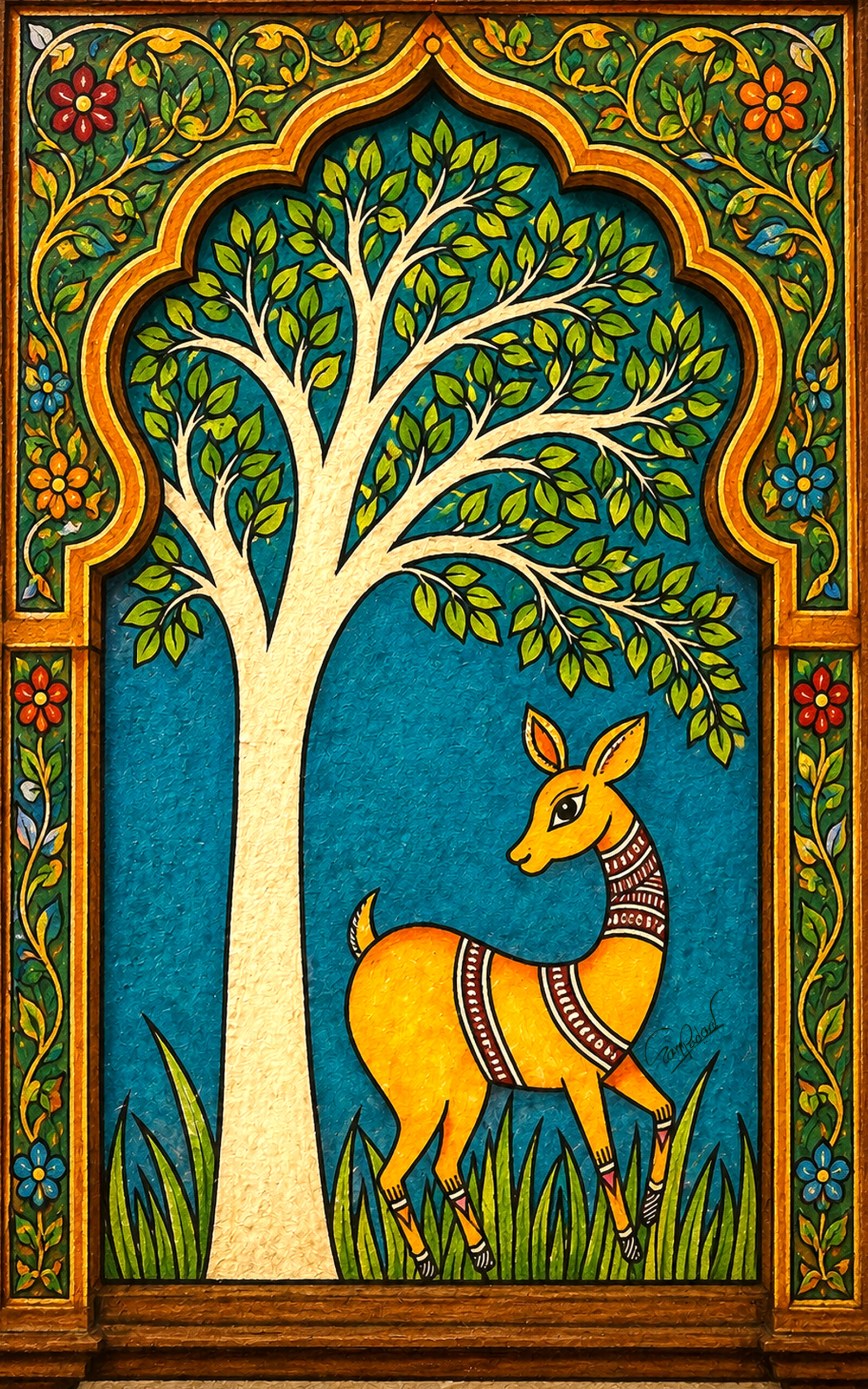
Madhubani, also called Mithila painting, began on the mud-plastered walls and floors of homes in Bihar’s Mithila region. Women traditionally painted it for festivals and weddings. Today it also lives on handmade paper, cloth and canvas.
The double line
Look at any border or outline. Two thin parallel lines, often with fine patterning between them, give the style its rhythm. Artists traditionally drew them with twigs, bamboo sticks or nib pens, so a real line often starts with a slight pool of pigment and thins as the hand moves.
That double-line border is the quickest visual test you have.
No empty space
Figures are flat and linear. Around them, the background is packed: leaves, fish, petals, geometric bands. If large parts of a “Madhubani painting” sit blank, you may be looking at a modern interpretation, not the traditional form.
Motifs repeat because they mean something. Fish and lotus appear in wedding imagery as signs of fertility and prosperity, and the tree of life stands for life itself. A painter places them with intent, so an original Madhubani painting tends to balance them across the surface rather than scatter them at random.
Five styles, one family
Madhubani is an umbrella for five styles. Knowing them helps you read what you are buying.
| Style | What to look for |
|---|---|
| Bharni | Bright, fully filled colour and religious figures |
| Kachni | Fine linework in one or two tones, little filled colour |
| Tantrik | Tantric symbols, deities and sacred diagrams |
| Godna | Tattoo-inspired motifs, often black and white |
| Kohbar | Wedding imagery of love and fertility: lotus, bamboo, fish |
Godna, for instance, grew out of women’s tattooing traditions, and it still favours fine black lines on a plain ground.
Comparing Madhubani with other Indian styles? Our Tanjore paintings buyer’s guide sets several traditions side by side.

How Can You Tell if a Madhubani Painting Is Hand-Painted or Printed?
This is the question most buyers cannot answer from a photograph. Generic art guides cover prints, and Madhubani guides cover style. Almost none connect the two. So here is how a painter checks an original Madhubani painting against a print, handmade vs printed, in the hand.
Raking light
Hold a torch almost flat against the surface and move it slowly. Acrylic leaves faint ridges where a stroke starts, ends or overlaps another colour, whereas printed ink usually lies flat.
The test is strongest on opaque colour. Thin washes show less relief, so judge several areas.
A 10x loupe
A jeweller’s loupe costs little and settles a great deal. On a print, flat colour resolves into scattered dots or a regular rosette pattern. On paint, you see continuous pigment, soft edges and the odd bristle mark.
Check the black linework in particular. Is it solid and slightly raised? Or is it a field of tiny dots?
Line wobble and pressure
Hand-drawn lines have character. The stroke swells where the nib pressed, thins at the turn, and the second line of a double border never runs perfectly parallel to the first. Two fish in the same painting will be cousins, never twins.
A reproduction repeats its flaws exactly. Compare identical motifs for tiny differences.
Back, edges and paper
Turn the work over. On canvas, look for stretcher bars, staples and hand-finished edges. On paper, look at the fibre: handmade paper has an uneven, slightly rough tooth and often a deckled edge. A glossy, even surface with a printed margin is a warning.
A signature should sit in pigment on the front. A printed one breaks into dots under the loupe.
One honest caveat. A hand-embellished print can pass some of these checks, because someone has painted over the copy. That is why you run several.
Buying online? Ask for three photos
A trustworthy seller will not mind. Ask for a close-up of the black linework, a photograph taken from a low side angle so the surface texture shows, and a shot of the back. Hesitation tells you something.
If all you receive is the same studio-lit image, keep your money where it is.

Natural Colours or Acrylic: Does It Decide Authenticity?
Many sellers lead with “natural colours”. The traditional palette did come from plants, turmeric, indigo and soot, as the craft body AIACA notes, and natural pigment on handmade paper is a lovely thing to own in an original Madhubani painting.
But it is not a purity test. Established sellers themselves admit that permanent colours are now widely used on canvas and fabric. One leading guide even concedes you cannot reliably tell natural from synthetic by looking at a finished piece.
So treat “natural colours” as a claim to be supported. Ask the artist what was used and why. A confident answer, with a photograph of the pigment bowls, tells you more than the word on the listing.
Acrylic on handmade paper or canvas is an honest, durable choice. It simply deserves an honest price.

What the GI Tag Proves (and What It Doesn’t)
Madhubani painting received a Geographical Indication tag in 2007. The tag protects the name by region. It is not a sticker that comes attached to every painting.
A November 2025 Down To Earth column argues the tag has not done enough for the artists themselves. The applicant was a state government office, not an artists’ group. Hundreds of households in Jitwarpur alone paint, far more than the registry lists as authorised users. The same piece notes that some overseas online sellers market work as original while the village artists behind it receive a small share.
Two practical lessons follow. A painting without GI paperwork is not automatically fake. And a listing that simply says “GI tagged” is not automatically an original Madhubani painting.
Five questions to ask any seller
Ask these before you pay for an original Madhubani painting. Honest sellers answer quickly.
- Who painted this, and may I see their name?
- Which village, cooperative or studio does it come from?
- What are the medium and the base: natural pigment, acrylic, handmade paper or canvas?
- Can you share process photos or a short video?
- Will it arrive with a signed certificate of authenticity?
A certificate is a promise from the seller, not a government record, so judge it by the name printed on it. If you want a painting from Bihar artists directly, look for cooperatives and craft bodies that list artists by name and village.
Madhubani or “Madhubani-Style”? How to Read the Listing
Wording matters more than most buyers realise. “Madhubani painting” can describe a work by an artist from Mithila. It can also describe a design in the Madhubani manner, painted elsewhere by someone trained in another tradition, or a machine copy of either.
The first two are both legitimate, provided the seller says which one you are getting. Trouble starts when “inspired by” quietly disappears from the headline.
Read the verbs. “Painted by” followed by a named artist is a claim you can check. “In the style of” tells you it is an interpretation. Silence about the painter is the weakest sign of all.
An original Madhubani painting from Mithila arrives with a name, a place and a story. An honest interpretation arrives with a name too, and a clear label.
How Much Does an Original Madhubani Painting Cost in India?
Price is where fakes give themselves away. Labour is the main cost: a filled double-line composition takes days, not hours.
Four things move the number:
- Size. A larger composition takes longer to fill.
- Base. Handmade paper and canvas cost differently.
- Pigment. Natural colour takes more effort to prepare.
- The artist’s standing. Reputation counts.
Framing and shipping are usually extra.
| Type of work | Indicative range seen on public listings | Notes |
|---|---|---|
| Small piece (about 5×4 in) | From about ₹1,000 | Simple motifs; one listing we saw sat at ₹1,390 |
| Large piece (22×30 in), artist-signed | Roughly ₹12,000 to ₹25,000 | The top of the range we saw was ₹24,990 |
| Collector pieces, senior or award-winning artists | Far higher | One gallery page lists items up to ₹1,25,000 |
Indicative only, compiled from public listings on 26 November 2026. Check the live price and the artist before you pay.
A 22×30 in painting offered as “hand-painted” at a fraction of that floor deserves questions. Who is being paid? Natural pigment, a named artist and a signed certificate each add to the price, and each is worth asking about.

Where to Hang a Madhubani Painting
An original Madhubani painting is dense, so give it a calm wall. Off-white or soft neutral walls let the pattern breathe. A living room wall above a console, a dining wall or a pooja room all suit it.
Motifs carry meaning. Fish, peacock and the tree of life appear again and again. Many Vastu practitioners associate fish with prosperity and the peacock with grace. Treat this as tradition rather than rule, and speak to your own Vastu consultant if placement matters to you.
Light it from the side, as you did for the test. Raking light makes the ridges of a real brushstroke glow. [PRODUCT-LINK: Vastu paintings collection URL, to be confirmed]

Where Artace Studio Fits In
Plain words first. Artace Studio is a studio of painters, not a Mithila cooperative. Our work is painted by our own artists in acrylic on premium canvas, and we do sell the artwoek GI-region Madhubani art, which are made or produced in the Mithila region artists.
What we offer is a different kind of assurance. You begin with a conversation about your space. An artist sketches the idea for your approval before any paint touches the canvas, then confirms the palette with you. You see progress updates as the piece comes to life, and approve the finished work before it travels to you.
If you want a Madhubani-inspired original painted for your wall, that process removes the guesswork. Prefer a contemporary subject? Our guide to modern Radha Krishna painting walks through five modern styles.
Choosing With Confidence
An original Madhubani painting reveals itself to patient eyes. The double line wavers slightly. Colour sits on the surface with a soft, matte presence, and the back tells its own story. Test it, ask the seller five plain questions, and the print has nowhere to hide.
When you are ready to acquire a piece for your home, let it be one you can trace to a hand. The collection is open to view at your convenience, and a consultation costs nothing.